Fraction Terms
Fractions are taught at the upper middle school level. Basic concepts are needed to proceed.
- Numerator – The top part of a fraction. In the fraction 3/8, 3 is the numerator.
- Denominator- The bottom number in a fraction. In the fraction 3/8, 8 is the denominator.
- Factor – A number that divides another number evenly without a remainder. 8 is a factor of 16,
- GCD – Greatest Common factor between two numbers used to reduce fractions.
- LCM – The Least Common Multiple, used to add and subtract fractions.
- Equivalent Fractions – Two fractions with different denominators that are equal. 4/16 = 1/4
- Prime Number – a number that only has two factors, 1 and that number. There are 25 prime numbers up to 100. 2,3,5,7,11,13,17,19, 23, 29, 31, 37,41, 43, 47, 53,59, 61,67,71,73, 79, 83, 89, 97 are prime.
- Composite Number – a positive integer that has more than two factors. A number that is not prime.
- Integer – A whole number that is not a fraction.

Reducing Fractions Using the GCF
Reducing fractions is essential when getting the correct answer. If the fraction has zeros, it is easy to cancel them out to reduce it instantly. As an example, 300/700=3/7.
For more complicated fractions, find the GCF of the numerator and denominator. To reduce a fraction like 24/30, find the GCF of 24 and 30. The factors of 24 are 1,2,3,4,6,8,12,24 and the factors of 30 are 1,2,3,5,6,10,15,30. The GCF would be 6. Then divide both the numerator and denominator by 6 to get the fraction 4/5. By dividing by any other common number would not find the equivalent fraction in its simplest form.

Adding Fractions Using the Least Common Multiple
Adding fractions with the same denominator is easy. Just add up the numerators. As an example, 1/7 + 3/7 = 4/7
When the fractions have different denominators, you must make the denominators the same by using the Least Common Multiple. As an example 1/5 + 1/6, you need make the denominators the same before you add them. To make them the same, you need to find the LCM of 5 and 6 which is 30. Then convert 1/5 into XX/30, The answer is figured by dividing the denominators and then multiplying it by the numerator. Here 30/5=6 x 1=6 so 1/5 = 6/30. 1/6 is equivalent to XX/30 so 30/6=5 X 1=5. So 1/6=5/30. In total 6/30 +5/30 = 11/30

Multiplication and Division of Fractions
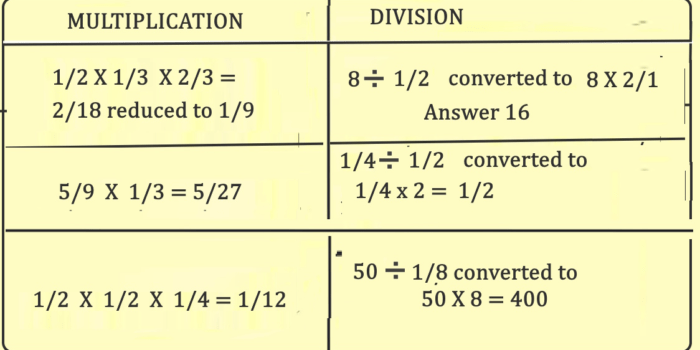
Multiplication of fractions is easy. Just multiply the numerators and the denominators and then reduce your answer. As an example: 2/3 X 1/2 = 2/6, reduced to 1/3.
To divide a fraction, just invert the second fraction and then multiply. For example: 1/3 divided by 3/5 = 1/3 X 5/3 = 5/9
Improper Fractions and Mixed Numbers
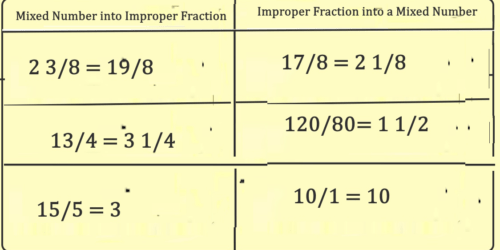
An improper fraction is When the numerator is larger than the denominator. It can be converted to a mixed number easily, Divide numerator by the denominator. Take the remainder and put it as the numerator in the mixed number. Example 9/7 is 1 with a remainder of 2 or 1 2/7,
To make an improper fraction out of a mixed number , take the denominator in the fraction and multiply it by the whole number to get the numerator. Leave the denominator the same. Example: 3 2/4 = 14/4